
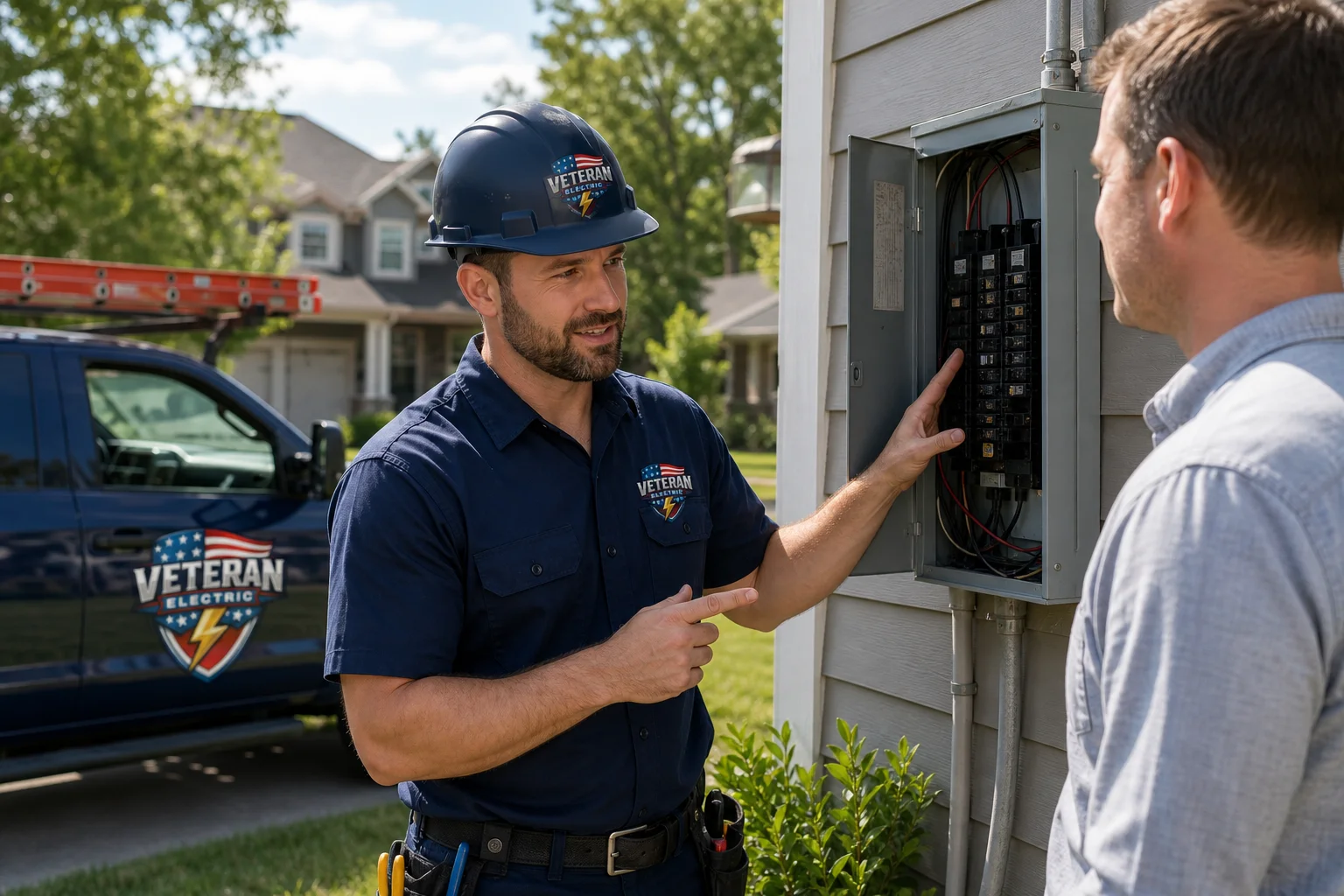
Summer electrical safety becomes critical the moment Kansas City temperatures climb and your air conditioner runs nonstop. High AC demand strains circuits, overheats wiring, and raises the risk of fires and shocks, especially in homes with aging panels. Knowing how heat stresses your Residential Electrical Services system keeps your family protected all season.
By Veteran Electric Team, KC Licensed Electricians
Why Summer AC Demand Stresses Your Home's Wiring
When temperatures hit 95 degrees, your central air conditioner does not just run more often. It draws significantly more current. A standard 3-ton residential AC unit pulls between 15 and 20 amps at steady state and can spike to 30 amps or more during a hard start. When dehumidifiers, refrigerators, and window units run at the same time, your panel has to supply all of it simultaneously.
Older Kansas City homes, particularly those built before 1980, often have 100-amp service panels designed for far lower total loads. Today's homes with central AC, electric ranges, and EV chargers can demand 150 to 200 amps or more during peak summer hours. That gap between panel capacity and actual household demand is where electrical problems begin.
Heat also reduces wire capacity. As ambient temperature rises, copper conductors run hotter under the same load. The National Electrical Code accounts for this through ampacity correction factors, but wiring installed decades ago may not have the thermal headroom for today's summer loads. The result is insulation that softens, connections that corrode faster, and breakers that trip more frequently.
Homes built before 1970 may also carry additional risk from aging wiring systems. Knob and tube wiring, identifiable by its ceramic knob and tube insulators and its lack of a ground wire, was common through that era and was never designed for today's electrical loads. If your attic or basement wiring looks unfamiliar or your home has never been rewired, a licensed electrician can inspect it before summer heat pushes those circuits past their limits.
Overloaded Circuits: Warning Signs You Cannot Ignore
Overloaded circuits are one of the most common summer electrical problems in Kansas City homes. When a circuit carries more current than it is rated for, the wiring heats up. If the circuit breaker fails to trip in time, that heat can ignite insulation or nearby wood framing.
Symptoms of an overloaded circuit include breakers that trip repeatedly under normal use, outlets or switch plates that are warm or hot to the touch, lights that flicker or dim when the AC kicks on, a burning or plastic smell near the panel, and discoloration around outlet covers.
If your breakers trip often during summer, that is not just an inconvenience. It is a signal that deserves investigation, and we cover how to read repeated breaker trips as warning patterns before they become a hazard.
Surge damage is another summer risk. When the utility grid fluctuates during storms or high-demand periods, voltage spikes can reach your appliances in milliseconds, and a point-of-use power strip offers far less protection than a whole-home surge protector installed at your panel.
If you notice any of these warning signs, do not wait. Our Emergency Electrical Services team responds to urgent electrical issues across the Kansas City metro.
Ground Fault Circuit Protection in Wet and Outdoor Spaces
A ground fault circuit interrupter, commonly called a GFCI, is one of the most important safety devices in your home. A ground fault circuit occurs when current finds an unintended path to ground, often through a person. GFCI outlets monitor the current flow in real time and cut power in as little as 1/40 of a second when they detect a fault circuit imbalance as small as 5 milliamps.
In summer, ground fault circuit protection matters most where water and electricity are close together: bathrooms and kitchens where hands are often wet, garages where hoses and equipment enter from outside, pool and spa areas where electrical contact with water can be lethal, and outdoor outlets exposed to rain, sprinklers, and humidity.
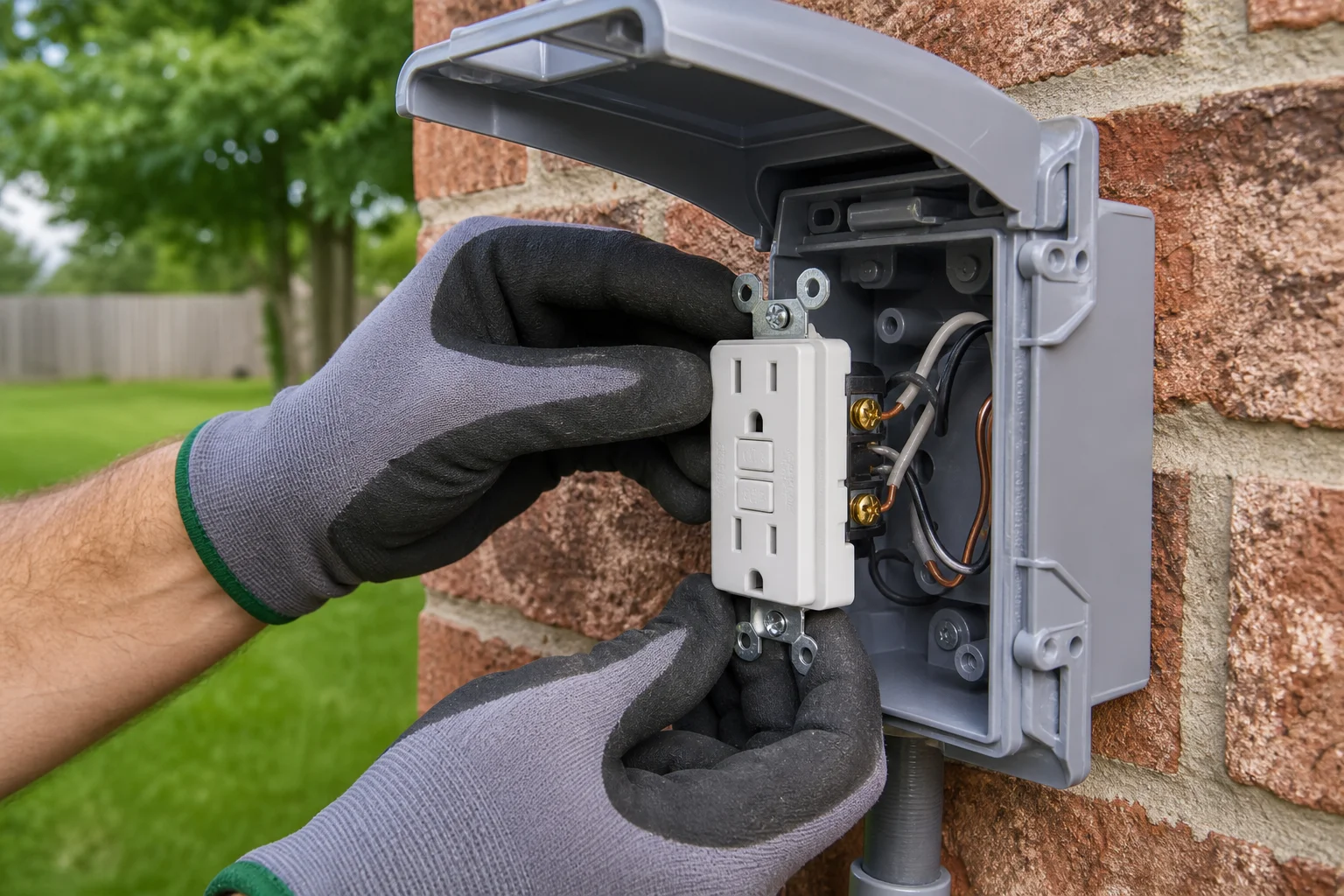
The National Electrical Code requires GFCI protection in bathrooms, garages, kitchens, crawl spaces, and all outdoor locations. If your home was built before these requirements were adopted, or if outdoor outlets were added without proper protection, you may have gaps that a licensed electrician can identify and correct.
Outdoor Electrical Safety When Summer Activity Peaks
Outdoor electrical hazards increase from June through August as families spend more time outside, contractors work on pools and landscaping, and summer storms arrive without much warning.
Power lines deserve constant awareness. Never operate ladders, scaffolding, or equipment near power lines. The Occupational Safety and Health Administration defines a minimum safe approach distance of 10 feet for unqualified workers near energized power lines. Contact with overhead power lines is consistently one of the leading causes of electrical fatalities in outdoor environments according to OSHA's fatality inspection data.
Extension cords are not permanent wiring. Extension cords are rated for temporary use only. Running extension cords through windows, under rugs, or outdoors year-round creates insulation wear, tripping hazards, and potential ignition points. Any outdoor outlet that requires a permanent connection needs a weatherproof box and proper wiring by a licensed electrician.
Pools and spas require dedicated circuits. Pool wiring must follow NEC Article 680 requirements for bonding, grounding, and GFCI protection to prevent electrocution in and around water. If you are adding a pool or hot tub this summer, the electrical portion is not a DIY project.
Summer Electrical Safety Tips Every Kansas City Homeowner Should Follow
A few direct safety tips reduce the risk of fire, shock, and system failure throughout the warm months.
Have your panel inspected before peak heat arrives. If your home has a 100-amp panel and central AC, ask a licensed electrician whether your service capacity matches your actual load.
Do not overload extension cords. Match the cord's amperage rating to the load. A 16-gauge cord rated for 13 amps cannot safely power a window AC unit that draws 15 amps.
Test GFCI outlets monthly. Press the test button on each GFCI outlet or breaker. The outlet should go dead. Press reset to restore power. A GFCI that does not trip during the test has failed and needs replacement.
Keep outdoor outlets covered. Weatherproof in-use covers protect outlets from rain and insects. Standard covers only protect empty outlets; in-use covers allow a cord to pass through while still sealing against moisture.
Stay safe around downed lines. If a storm brings a power line down near your property, treat every downed wire as live. Call 911 and your utility immediately. Do not approach, touch, or attempt to move a downed line under any circumstances.
Frequently Asked Questions
Can running my AC all summer damage my electrical system?
Constant high demand accelerates wear on circuit breakers, wire connections, and your panel. If your system is properly sized for the load, normal AC use should not cause lasting damage. Problems arise when aging panels, undersized wiring, or faulty connections are already present. A professional inspection before peak summer heat identifies those weak points before they become failures.
How do I know if I need a panel upgrade?
Signs include breakers that trip frequently, a panel with 100-amp service in a home with central AC, fuses instead of breakers, or double-tapped breakers where two wires share one breaker slot. If you are adding an EV charger or a hot tub, your electrician should calculate whether your current service capacity can handle the added load.
Are outdoor extension cords safe for summer use?
Extension cords marked for outdoor use with a W in the rating are water-resistant but still designed for temporary use. They degrade with UV exposure over multiple seasons. Never bury them, run them under grass, or leave them coiled and connected when not in use. For any permanent outdoor power need, install a proper outlet with a weatherproof cover.
What is a ground fault circuit interrupter and where do I need one?
A ground fault circuit interrupter is a device that cuts power when it detects current leaking outside the intended circuit path. You need GFCI protection anywhere water and electricity can meet: bathrooms, kitchens, garages, outdoor outlets, and near pools. Current NEC code requires them in all of these locations, and retrofitting older homes is a straightforward job for a licensed electrician.
What should I do if my lights flicker when the AC starts?
Brief flickering on startup is common as the AC motor draws a surge of current. If flickering is severe, lasts more than a second, or affects multiple circuits, it can indicate a loose connection, undersized wiring, or a failing breaker. Have a licensed electrician inspect the circuit before the issue worsens.
Schedule Your Summer Electrical Safety Check with Veteran Electric KC
High summer demand exposes every weakness in an aging electrical system, and Kansas City heat does not wait for a convenient time to cause problems. Whether you need a panel inspection, GFCI upgrades, or outdoor outlet installation done right, the licensed electricians at Veteran Electric KC are ready to help. Contact us today to schedule a safety evaluation and keep your home running reliably all season long.


