
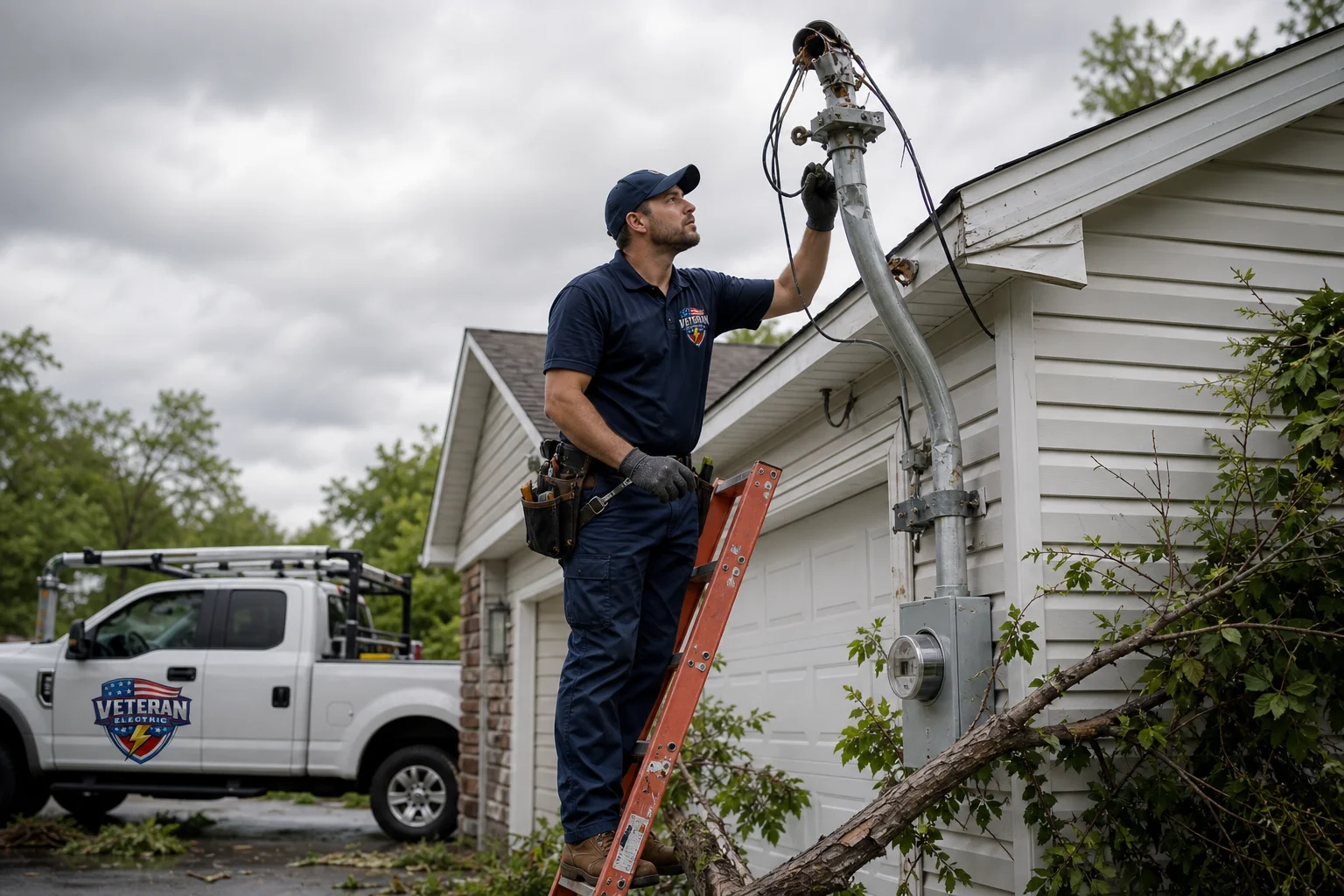
Storm damage to your service mast or weatherhead can knock out power, expose live wiring, and put your family at risk within seconds after a storm passes through Kansas City. If your mast is bent, cracked, or pulled away from the house, call our Emergency Electrical Services team before you go near the panel.
By Veteran Electric Team, KC Licensed Electricians
What Is a Service Mast or Weatherhead, and Why Does It Matter After a Storm?
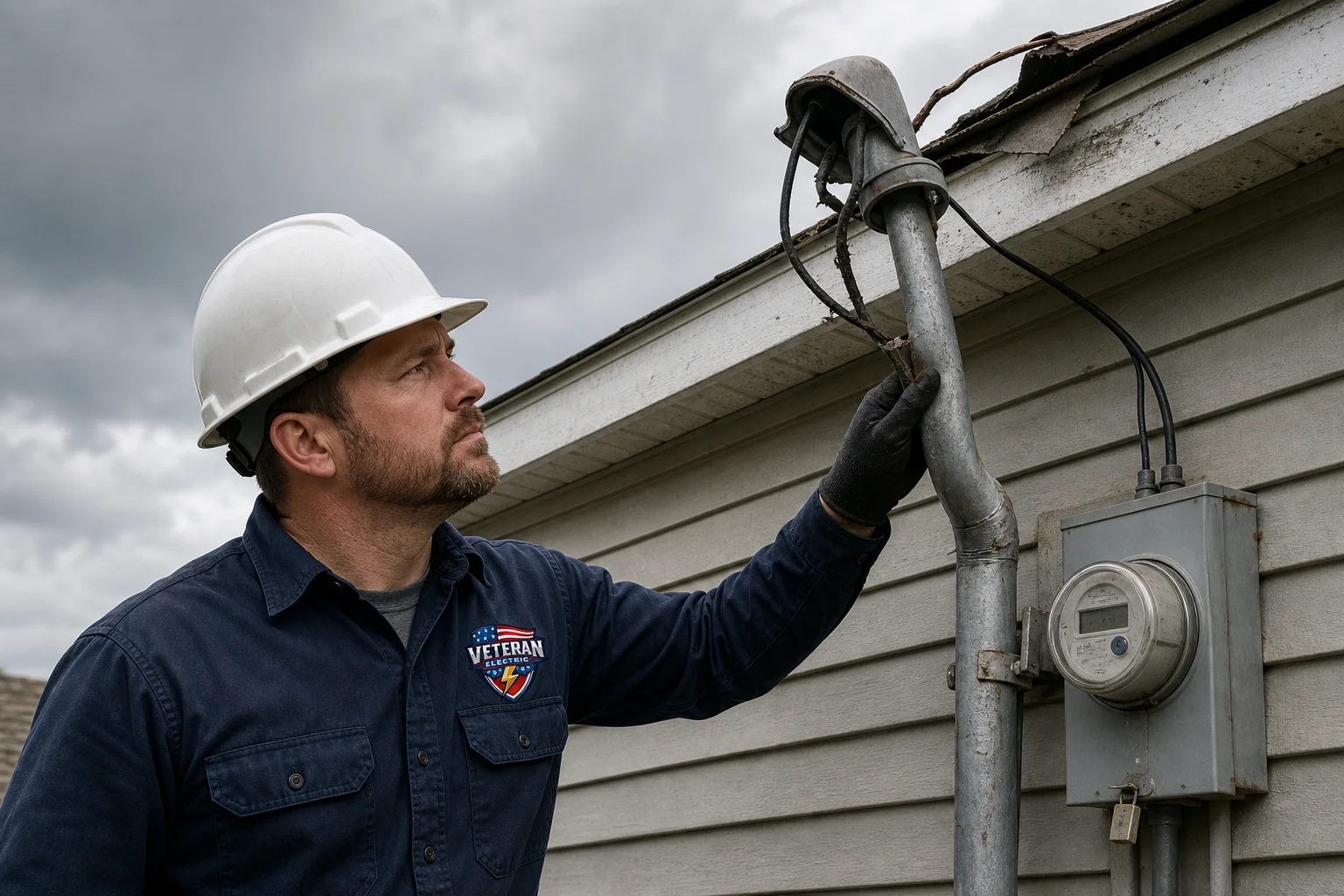
The service mast is the vertical metal pipe that runs from your roofline down to the meter base, carrying your electrical service into the house. At the top sits the weatherhead, a curved fitting where the utility's service drop, the overhead wire from the pole, connects to your home's wiring and keeps rain out of the conduit. Because the mast is the single point where outside power becomes your home electrical system, any bend, crack, or pull at this connection threatens both the wiring inside and the wires still carrying utility power outside. Wind, ice, and falling limbs regularly damage this assembly during Kansas City storms, and a compromised mast is one of the more common calls our licensed electricians take after severe weather rolls through the metro.
What Are the Signs of Storm Damage to a Service Mast or Weatherhead?
Kansas City storms bring straight line winds, hail, and the occasional microburst, a sudden, powerful downdraft the National Weather Service tracks as a common cause of localized wind damage in the Midwest. Any of these can stress the pipe, the weatherhead, or the wires running into your home electrical system. Signs your service mast or weatherhead needs attention include:
- A visible bend, lean, or gap where the mast pulls away from the house or roofline
- A cracked, dislodged, or missing weatherhead, especially after high wind or a falling tree limb
- Wires sagging low from the service entrance or resting against the roof, gutters, or siding
- A loose or hanging meter box, or a meter base that has pulled away from its mounting
- Scorch marks, buzzing, or a burning smell near the mast, meter, or main panel
- Breakers tripping repeatedly, or power flickering, after a storm passes through
If you notice any of these, keep everyone clear of the area and call a licensed electrician before assuming the damage is only cosmetic.
Is a Damaged Service Mast or Weatherhead Dangerous?
Yes. A damaged service mast or weatherhead is a genuine electrical service hazard because the wires above the meter, from the weatherhead down to the meter base, are still energized by the utility even when your home has no power. If the mast is bent, split, or torn loose, stay away from it and keep family, pets, and anyone else clear of the area, especially if wires are drooping or touching anything metal or wet. Do not attempt to cut power at your main breaker if reaching the panel means walking near a downed or leaning mast; call your utility's emergency line and a licensed electrician instead, and treat every wire as live until a professional confirms it is safe. If you smell burning plastic, see sparking, or notice outlets are hot to the touch, that is an emergency and it deserves an immediate call.
Who Is Responsible for a Damaged Service Mast, You or the Utility Company?
Understanding who repairs storm damage to your service mast or weatherhead starts with knowing which parts of the system you own. In most cases, the mast, weatherhead, and meter base mounted on your house are your responsibility, while the utility company owns the service drop, the wire strung from the pole to your weatherhead, along with the meter itself. That split means a homeowner is usually responsible for arranging and paying for mast repairs, even when a fallen tree limb or a downed utility line pulled the mast loose in the first place. Because ownership lines vary by utility provider and can affect permitting, it is worth confirming the exact boundary with your provider before repairs start. Our Residential Electrical Services team coordinates directly with the utility so the service drop gets reconnected the same day your mast repair is finished, instead of leaving your home without power any longer than necessary.
How Much Does It Cost to Repair Storm Damage to Your Service Mast or Weatherhead?
Repair costs depend on how much of the assembly needs to be replaced and whether the meter base or interior wiring was also affected. Our published rate structure charges a standard diagnostic fee to identify the full scope of the damage, then provides a fixed price for the repair itself, so you know the number before work begins. Simple repairs, such as resealing a weatherhead or straightening a mildly bent mast, might cost $150 to $300, while a full mast replacement, a damaged meter base, or complications from downed service drop wires can push the price higher. We always give you that price upfront rather than billing by the hour, and the exact figure depends on what our electrician finds during the on-site evaluation.
How Long Does It Take to Repair a Damaged Service Mast or Weatherhead?
A straightforward service mast repair is often a same-day job once the utility disconnects the service drop so our electricians can work safely, then reconnects it after the repair passes inspection. More involved jobs, such as a full mast replacement, a cracked meter base, or fire damage inside the panel, can take longer if parts need to be sourced or if the utility's disconnect and reconnect scheduling adds a delay. For homeowners who lose power for more than a few hours during a busy storm season, a portable generator paired with a properly installed transfer switch is a safer bridge than running extension cords through a window, and it keeps essential circuits running until your permanent electrical service is restored.
Frequently Asked Questions
Does homeowners insurance cover storm damage to your service mast or weatherhead?
Many homeowners insurance policies cover storm damage to your service mast or weatherhead when wind, a falling tree, or another covered peril caused it, since the mast is considered part of your home's structure. Coverage details, deductibles, and whether the utility's portion of the service drop is included vary by policy, so call your insurance company and request an adjuster before repairs begin, then keep the repair invoice for your claim.
Can I still have power in my house if the weatherhead is damaged?
Usually not for long. If the weatherhead is cracked or pulled loose, moisture can enter the mast and reach the meter base and panel, so the utility company will often disconnect service at the pole until repairs are complete and pass inspection. In some cases a licensed electrician can arrange a temporary safe connection, but this depends on the extent of the damage and your utility's rules.
Do I need a permit or inspection to repair a damaged service mast?
In most Kansas City area jurisdictions, yes. A damaged service mast is part of your home's electrical service, so replacing or repairing it typically requires a permit and a follow-up inspection before the utility will reconnect power. Requirements and turnaround times vary by city, and understanding the local electrical permit process ahead of time helps you avoid delays after a storm, since your electrician usually pulls the permit and schedules the inspection for you.
Can I repair a damaged weatherhead myself, or does it require an electrician?
This is not a do it yourself repair. The wires above the meter are energized by the utility, and working on a mast or weatherhead without a proper disconnect risks electrocution or fire even for an experienced homeowner. A licensed electrician has the training, insulated tools, and utility relationships to coordinate a safe disconnect, complete the repair to code, and get your reconnect inspection scheduled quickly.
Get Your Service Mast Repaired Before the Next Storm Hits
If your service mast or weatherhead was damaged in the last round of Kansas City storms, our veteran-owned team can inspect it, coordinate with your utility, and get your electrical service safely restored. Contact us today for a same-day evaluation and an upfront repair price.


