
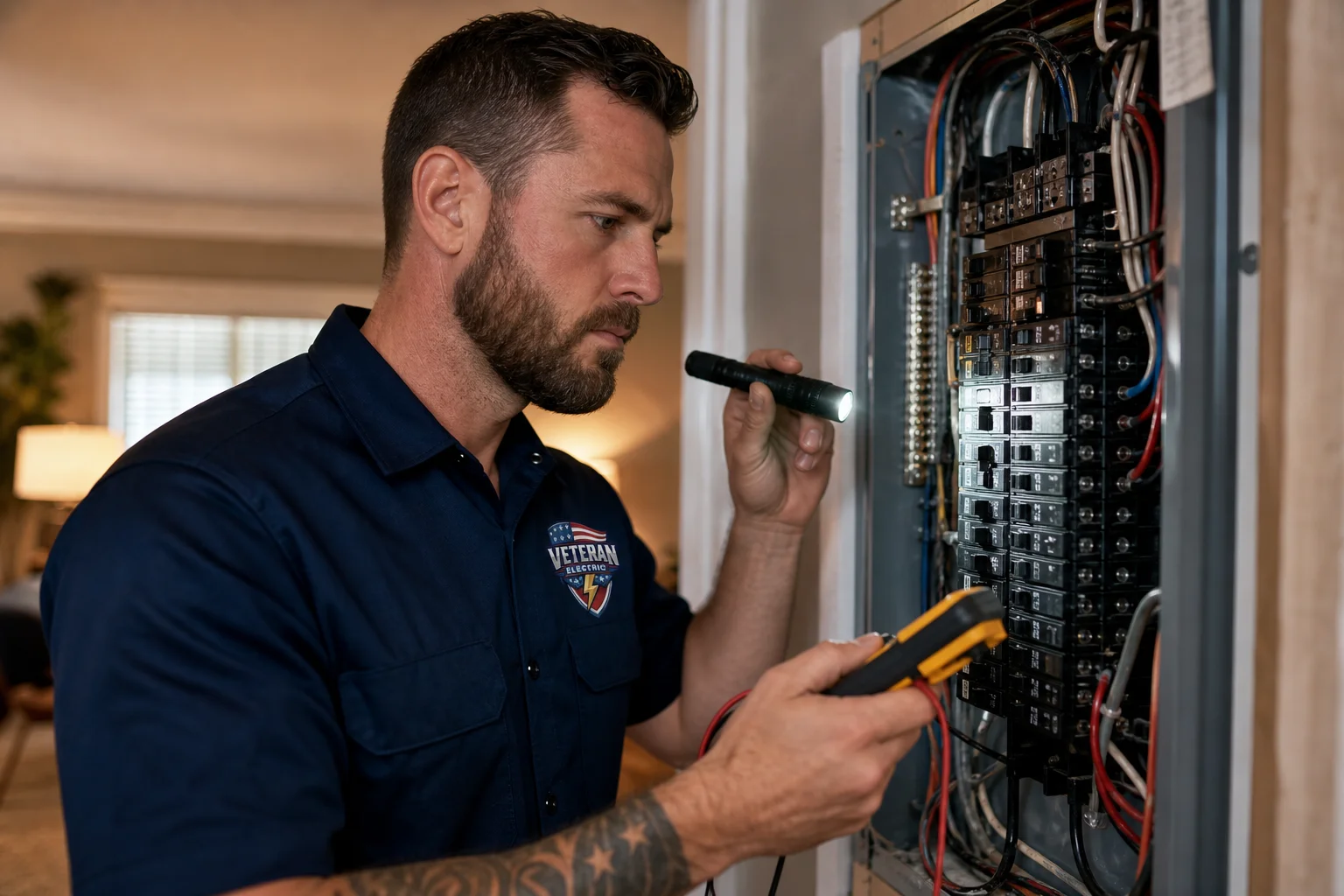
Kansas City homes with flickering dimming lights, frequent circuit breaker trips, burning smells, warm outlets, buzzing walls, or wiring from before 1980 are showing the 7 signs your Kansas City home needs rewiring and when it can wait depends on how many appear at once. Our Residential Electrical Services team helps you read each signal accurately.
By Veteran Electric Team, KC Licensed Electricians
Home wiring problems rarely announce themselves clearly. Most homeowners notice something is off long before they understand what it means. These seven warning signs, taken together, give you the clearest picture of where your electrical system stands.
1. Flickering or Dimming Lights Throughout the House
Flickering dimming lights in a single room often trace back to a loose bulb or a failing fixture. When the same pattern appears across multiple rooms, or when lights dim every time a large appliance kicks on, the cause is deeper. An overloaded circuit or an undersized service panel means the home electrical system cannot deliver stable power under load. The National Fire Protection Association identified electrical distribution equipment as a contributing factor in more than 44,000 residential fires in 2023 (NFPA, Home Structure Fires, 2023, retrieved from nfpa.org).
2. Circuit Breakers That Trip More Than Once a Week
Circuit breakers that trip occasionally are doing their job. Circuit breakers that trip repeatedly on the same circuit, or that refuse to reset and hold, have either exhausted their design life or are protecting a circuit that is genuinely undersized for what your home needs. Homes built before the 1980s frequently have 60-amp or 100-amp panels that were not sized for modern appliance loads.
3. A Burning Smell Near Outlets, Switches, or the Panel
A burning smell is the one warning sign on this list that is never a wait-and-see situation. Melting wire insulation produces an odor similar to burning plastic. If you detect it near an outlet, a switch, or your main panel, there is likely active arcing behind the wall. Arc faults are a direct ignition source for house fires. Cut the circuit at the panel and contact Emergency Electrical Services right away.
4. Warm, Discolored, or Sparking Outlets
An outlet that feels warm to the touch or shows brown or black scorch marks is signaling a loose connection or failing wire insulation inside the box. A single spark when you plug in a device is not always a crisis, but repeated sparking from the same outlet is a warning sign that deserves immediate attention.
5. Two-Prong Ungrounded Outlets Throughout the Home
Two-prong outlets lack the ground pin that protects modern electronics from surge damage and reduces shock risk. They were standard in homes built before 1965. If your home still runs two-prong outlets in most rooms, the home wiring predates modern safety codes. This does not always call for an immediate rewire, but it does require an honest assessment of what the home needs going forward.
6. Buzzing or Crackling Sounds Inside Walls
Electricity moves silently through properly installed wiring. Buzzing or crackling from a wall, outlet, or panel is an audible sign of loose connections, damaged insulation, or active arcing. Of the seven problems listed here, this carries among the highest risk because arc faults can ignite framing and insulation without any visible surface indication.
7. Wiring Installed Before 1980
Aluminum branch wiring, common from the mid-1960s through the 1970s, expands and contracts at a different rate than copper terminals, creating loose connections over time. Cloth-wrapped conductors and knob-and-tube runs from earlier decades have similarly aged past reliable service life. If you are unsure what type of wiring is behind your walls, confirming whether it's knob and tube wiring is worth doing before scheduling any additional work.
What Older Homes in Kansas City Are Actually Up Against
Many Kansas City neighborhoods built between the 1940s and 1970s have homes with partial or fully original electrical systems. Those systems were designed around far fewer devices than a modern household runs. A 100-amp panel that once served a family comfortably now shares load with EV chargers, smart appliances, home offices, and air conditioning units that pull significantly more current than equipment from that era.
The combination of pre-1980 wiring and modern device loads creates electrical problems that compound over time. Older homes tend to show multiple warning signs at the same time rather than one in isolation. Flickering dimming lights, frequent circuit breaker trips, and two-prong outlets often coexist in the same house because they all trace back to the same root cause: a home electrical system sized for a different era. Air conditioning units pull some of the highest continuous current draw of any household appliance, and that demand peaks during the same summer months when Kansas City heat pushes AC systems hardest. On a home already running an undersized panel or aging wiring, that added peak load is often what turns a marginal electrical system into one showing visible symptoms.
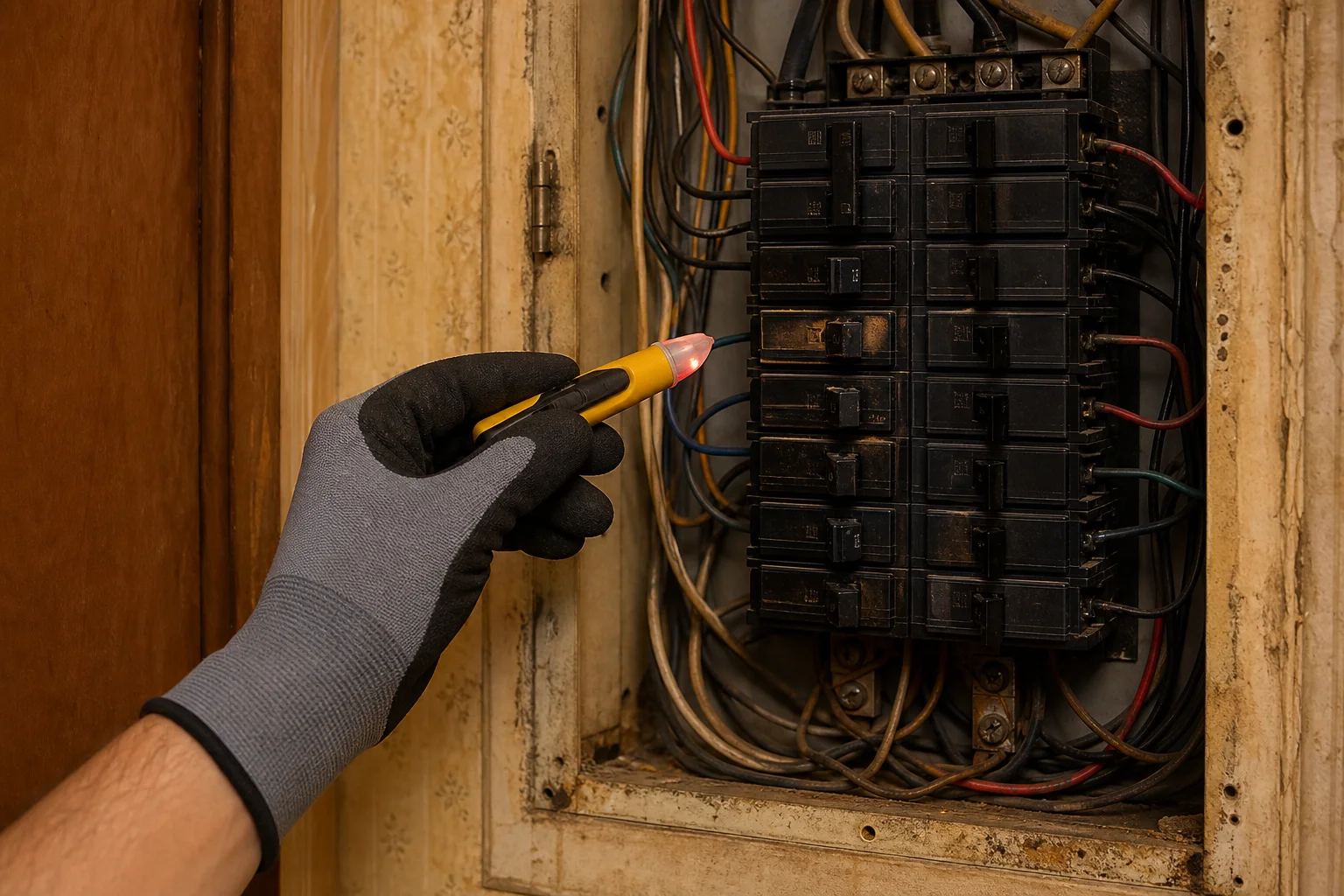
When the Warning Signs Mean Act Now vs. Plan Ahead
Not every item on this list calls for a full rewire this week. Here is a clear breakdown of urgency:
Act immediately:
- Burning smell from any outlet, switch, or panel
- Buzzing or crackling from inside a wall
- Scorched or sparking outlets
- A circuit breaker that will not reset or hold
Schedule within 30 days:
- Flickering dimming lights in two or more rooms
- Repeated circuit breaker trips on the same circuit
- Three or more warning signs appearing at the same time
Plan within the year:
- Two-prong outlets throughout the house with no active symptoms
- Pre-1980 wiring confirmed with no burning smell, buzzing, or repeated breaker trips
A partial rewire targeting the highest-risk circuits can often bring a home into safe operating condition without the cost of a full replacement. Knowing how to select a licensed contractor makes a real difference here, so it is worth understanding how to choose an electrician before you start gathering quotes.
What a Full or Partial Rewire Actually Involves
A full residential rewire replaces branch circuit wiring from the main panel out to every outlet, switch, and fixture. In occupied homes, most of this work runs through the walls without full drywall removal, though access points are necessary at specific locations.
Scope depends on:
- Total square footage and number of circuits
- Whether the main panel and service entrance need upgrading alongside the wiring
- Finished basement, attic, or wall conditions that affect access
Most rewires in a standard Kansas City single-family house complete in three to five days. Power goes offline to sections of the home in stages, and each section is restored before the crew moves forward. The best approach for most homeowners is to bundle arc-fault protection, additional circuits, or GFCI coverage into the same project. Arc-fault and ground-fault protection guard against different failure modes: arc-fault breakers watch for the electrical signature of arcing before it can ignite surrounding material, while GFCI protection responds to ground faults that create shock risk in wet locations like kitchens and bathrooms. Bundling both into the same rewire, along with any additional circuits the home needs, means the inspection and permitting process happens once instead of being repeated for each upgrade separately.
Frequently Asked Questions
How do I know if my home needs rewiring or just a panel upgrade?
If circuit breakers trip frequently but the underlying wiring is in good condition, a panel upgrade may resolve the problem. If the home has pre-1980 wiring, widespread two-prong outlets, or signs of damaged wire insulation, the wiring itself is the issue. A licensed electrician will assess both and give you a direct answer based on what they find.
Are all 7 signs your Kansas City home needs rewiring and when it can wait equally serious?
No. A burning smell or buzzing wall calls for same-day action. Widespread two-prong outlets with no active symptoms can be scheduled over months. The urgency depends on whether the electrical system shows signs of active arcing or overheating versus simple passive aging.
Can a partial rewire bring my home up to code?
Yes, in most cases. A partial rewire addressing the highest-risk circuits, such as kitchen, laundry, and bathroom runs, combined with GFCI and AFCI protection, satisfies current electrical code for those circuits. Remaining circuits retain their prior code compliance. Your electrician will specify what changes are required and what is optional.
How long does a typical Kansas City home rewire take?
Three to five days for a standard single-family home. Larger homes, fully finished basements, or homes with tight wall cavities may run longer. Ask for a firm timeline from your contractor before work begins and hold them to it throughout the project.
What happens if I delay rewiring despite active warning signs?
Active warning signs, specifically burning smells, buzzing from walls, and repeated arc-related breaker trips, indicate a home electrical system that is actively failing under load. The NFPA (2023) links electrical fires to more than $1.3 billion in residential property damage annually in the United States. Delay compounds risk in a way that a scheduled rewire does not.
Get a Straight Answer About Your Home's Wiring
If your Kansas City home is showing any of these warning signs, the best first step is a professional inspection from a licensed electrician who will tell you precisely what needs to happen and what can wait. Contact Veteran Electric today for an assessment from KC-licensed electricians who bring the same discipline to your home's electrical services that they brought to military service.


