
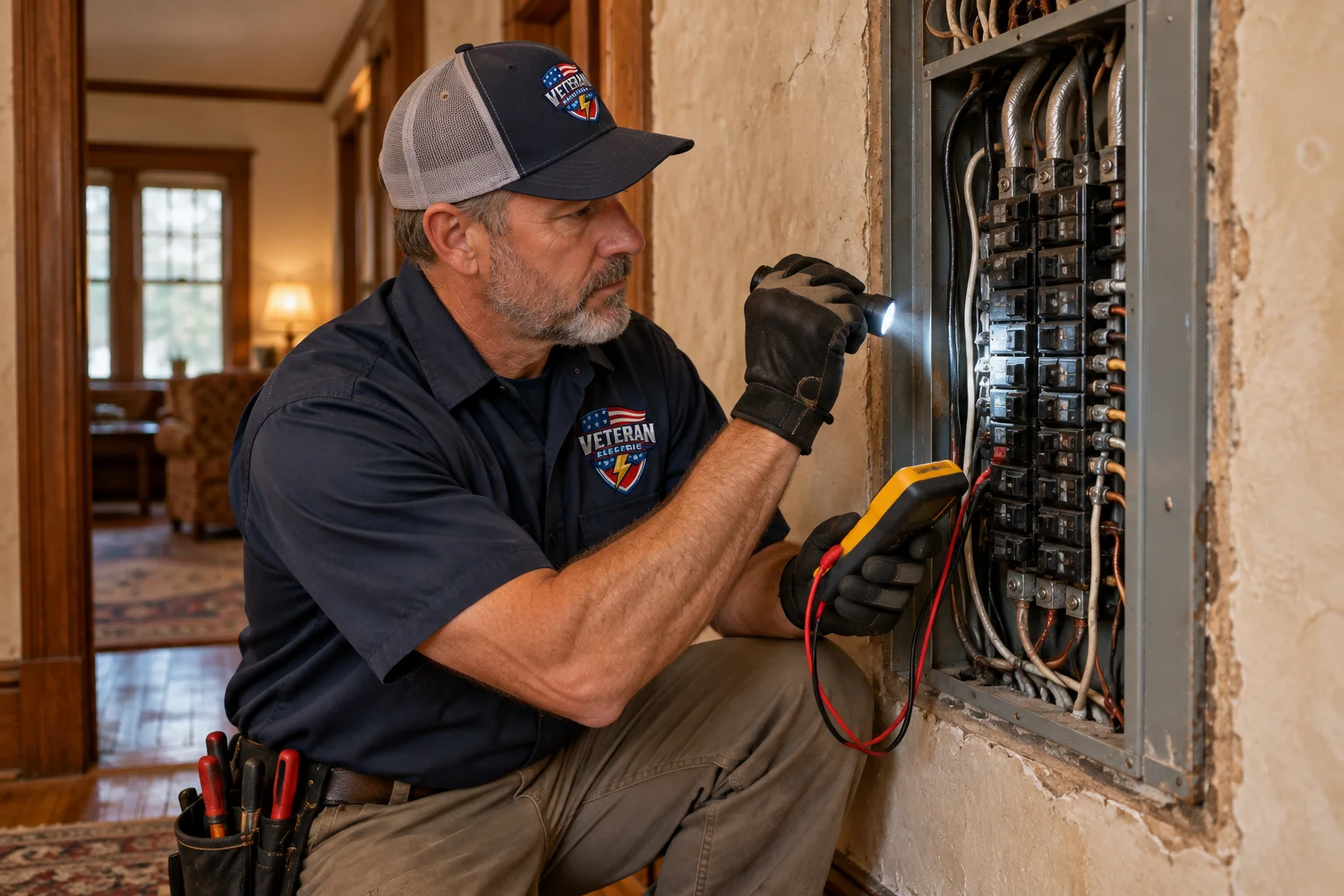
An old Kansas City house doesn't need guesswork, it needs an answer: does it call for a full copper rewire vs targeted remediation? The right call depends on wiring type, panel age, and how much of the house still runs on aluminum wiring, and our Residential Electrical Services team makes that call at the panel.
By Veteran Electric Team, KC Licensed Electricians
How Do You Know an Old Kansas City House Needs a Full Rewire Instead of Targeted Repairs?
Choosing between a full copper rewire vs targeted remediation comes down to one question: how much of the home's original wiring is still carrying live current, and how it's failing. A single warm outlet or one circuit that trips under load is a repair problem. Flickering, warm switch plates, and breaker trips spread across different rooms, on circuits built decades apart, is a wiring problem, and wiring problems that spread rarely stay contained for long.
What Factors Decide Whole-House Rewiring vs Problem-Area Fixes?
A few things move this decision. The age of the home and its original wiring method matter most: homes built before the 1960s often still carry knob-and-tube, while homes built between about 1965 and 1973 commonly used aluminum branch circuits. How much of that original wiring is still active, rather than already replaced, matters just as much, as does the number of prior patch repairs on the panel and whether an upcoming renovation will open walls anyway, since that's often the cheapest window to rewire a section that would otherwise cost more to access later.
Signs of Knob-and-Tube or Aluminum Wiring That Point to a Full Rewire
You can spot both from the attic or the panel without opening a wall. Knob-and-tube shows up as cloth-covered single conductors running through porcelain knobs and tubes, usually in an unfinished attic or basement. Aluminum branch wiring shows up as a dull, silver-gray single-strand wire at the outlet or switch box, sometimes stamped "AL" or "CO/ALR." A panel with a mix of both, or with visible scorch marks at a splice, means the risk isn't theoretical.
Warm outlets and flickering lights on a single circuit usually point to an isolated fix. The same symptoms spread across multiple rooms are among the clearest rewiring warning signs that a house's problem is systemic rather than local, and that distinction is what actually separates a repair from a rewire.
Full Copper Rewire vs Targeted Remediation: What Is the Difference?
A full copper rewire replaces the home's branch circuits house-wide with new copper conductors, typically paired with a new panel and updated grounding, so every circuit is built to current code rather than a mix of eras. Targeted remediation repairs or replaces only the specific circuits, connections, or runs actually causing problems, leaving the rest of the original wiring in place.
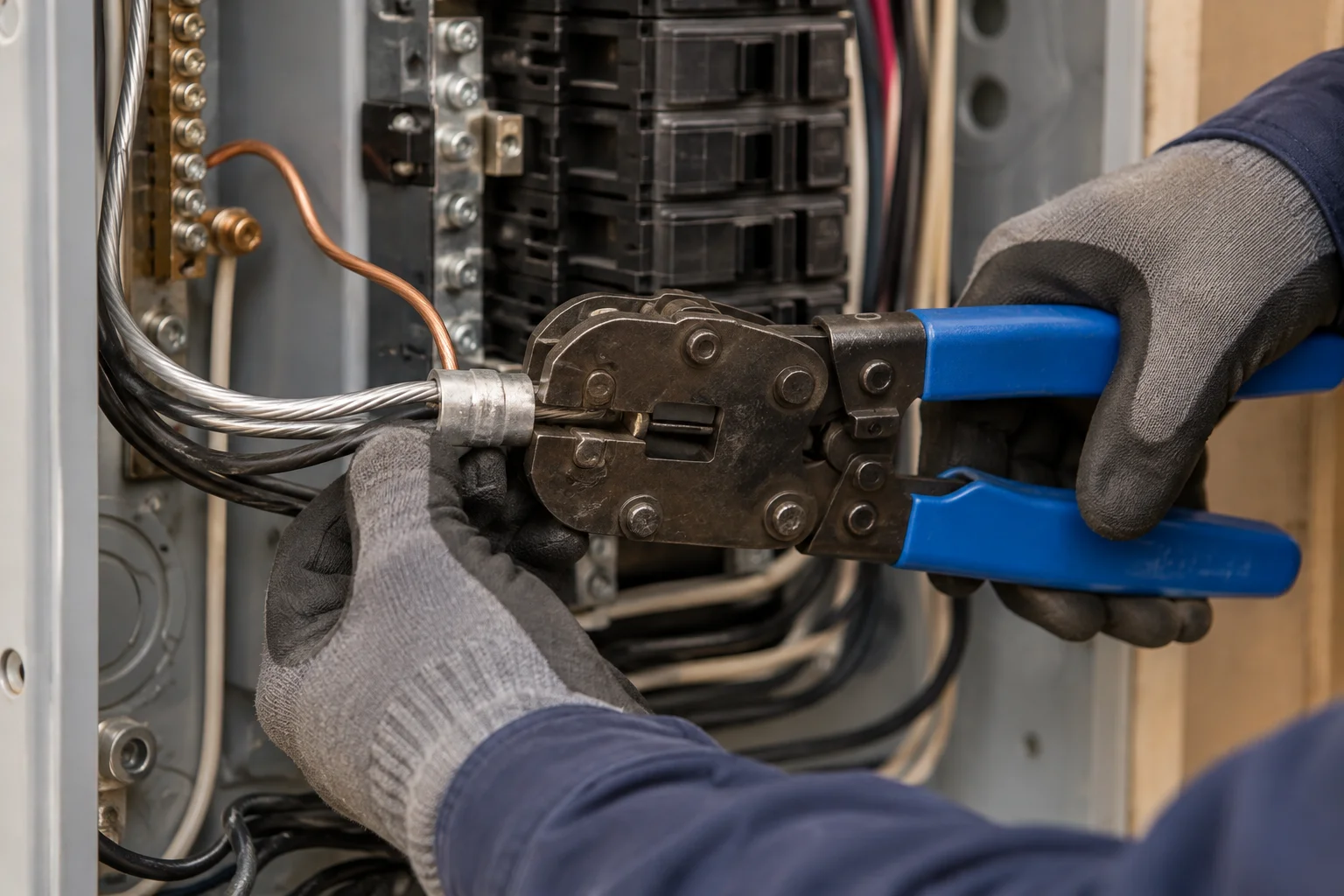
For aluminum branch wiring specifically, the failure point usually isn't the wire, it's the connection. Aluminum expands and contracts more than copper under heat cycling, which loosens screw terminals and outlet connections over time and creates the arcing risk homeowners are warned about. The Consumer Product Safety Commission recognizes the COPALUM crimp connector as an effective pigtail repair for that failure mode: a licensed electrician splices a short copper lead onto the existing aluminum wiring at each connection point, using specialized crimping tools built for that application, without removing the aluminum wiring itself. Done correctly, it addresses the real risk at the connection without the cost or disruption of a full rewire.
Cost Comparison: Full Rewire vs Targeted Remediation in Kansas City
A full copper rewire costs more upfront than targeted remediation because it touches the whole house: every branch circuit, the panel, the grounding system, and typically the drywall or plaster that has to be opened and patched to reach the wiring. Targeted remediation is scoped to specific circuits or connection points, so the labor, materials, and drywall repair are all smaller. But cost isn't just which method is cheaper per project, it's which path costs less over the life of the house.
Is It Cheaper to Rewire the Whole House or Fix Problems as They Come Up?
Targeted remediation is almost always cheaper for the first repair. Where that math shifts is a house with aluminum branch circuits or knob-and-tube spread across most rooms, where problems tend to surface one circuit at a time over several years. Each separate repair carries its own service call, drywall patch, and inspection, and several stacked over a decade can add up to more than a single rewire would have cost, without ever solving the underlying risk on circuits that haven't failed yet.
What Is the Average Cost to Rewire an Older Kansas City Home?
Cost scales primarily with square footage, the number of circuits, and how the walls are built, since two-story homes with plaster and lath typically run higher than a single-story home with drywall. A real number requires an onsite inspection rather than a phone estimate, because square-footage-based rewire pricing shifts with access, panel condition, and how much of the existing wiring can stay versus how much has to come out.
How Long Does a Full Copper Rewire Take Compared to a Targeted Repair?
A full rewire on an occupied home typically spans several days to about two weeks, depending on square footage, how many rooms need wall access, and whether the work is phased to keep power on for part of the house each night. Targeted remediation is usually a same-day or next-day job for a handful of circuits, since it doesn't require opening walls throughout the home or a full rough-in inspection.
Does Targeted Remediation Satisfy Insurance or Inspection Requirements?
Sometimes, and sometimes not, so confirm this in writing before committing to either scope. Many insurers flag aluminum branch wiring or knob-and-tube during underwriting and may require remediation before binding or renewing a policy. Some accept a licensed electrician's documentation of a COPALUM repair or a professional inspection report as proof the risk has been addressed; others require a full rewire regardless of what remediation has been done. Because the standard varies by insurer, the only reliable path is asking your insurance agent directly what their carrier requires, in writing, before scheduling either type of work.
How Disruptive Is a Full Rewire Compared to Targeted Electrical Repairs?
A full rewire means access to nearly every room, drywall or plaster patches at each opened section, dust control throughout the home, and some partial-power time while circuits transfer to the new panel. It's real disruption, even done efficiently. Targeted remediation stays contained to the rooms and circuits actually being fixed, so the rest of the house keeps running normally the whole time.
If a section of your panel is showing active arcing, heat discoloration, or a burning smell right now, that's not a scheduling decision, it's Emergency Electrical Services territory, and a licensed electrician should stabilize that circuit before any conversation about long-term scope.
Frequently Asked Questions
Does homeowners insurance require a full rewire if a house has knob-and-tube wiring? Sometimes. Many insurers treat active knob-and-tube as a higher underwriting risk since it has no grounding conductor; some require full replacement before binding a policy, while others accept documented remediation. The requirement varies by insurer, so confirm directly with your agent in writing before choosing a scope of work.
How can I tell if my house has knob-and-tube or aluminum wiring? Check an unfinished attic or basement first. Knob-and-tube looks like cloth-covered single wires running through ceramic knobs and tubes. Aluminum branch wiring shows as a dull silver-gray single-strand wire at outlets, sometimes stamped "AL" on the device. A licensed electrician can confirm both from the panel in one visit.
What is the average cost to rewire an older home in Kansas City? Cost depends on square footage, wall construction, and how many circuits and panel components need replacing, so a real number takes an onsite inspection rather than a phone quote. Two-story homes with plaster walls typically run higher than single-story homes with drywall.
Is it cheaper to rewire a whole house or fix electrical problems as they come up? Fixing problems as they surface is cheaper per repair, but on a house with aluminum branch wiring or knob-and-tube spread through most rooms, several separate repairs over years can add up to more than one rewire, without addressing the circuits that haven't failed yet.
What is the difference between a full copper rewire and targeted electrical remediation? A full rewire replaces branch circuits house-wide with new copper and typically a new panel, bringing every circuit to current code. Targeted remediation repairs or replaces only the specific circuits or connections causing problems, leaving the rest of the original wiring in place.
Get a Straight Answer on Your Home's Wiring Plan
An onsite panel and attic inspection is the only way to know whether your house actually needs a full rewire or whether targeted remediation solves the real problem, and our licensed team will give you that answer in plain terms before any work starts. Contact Veteran Electric to schedule an inspection.


