
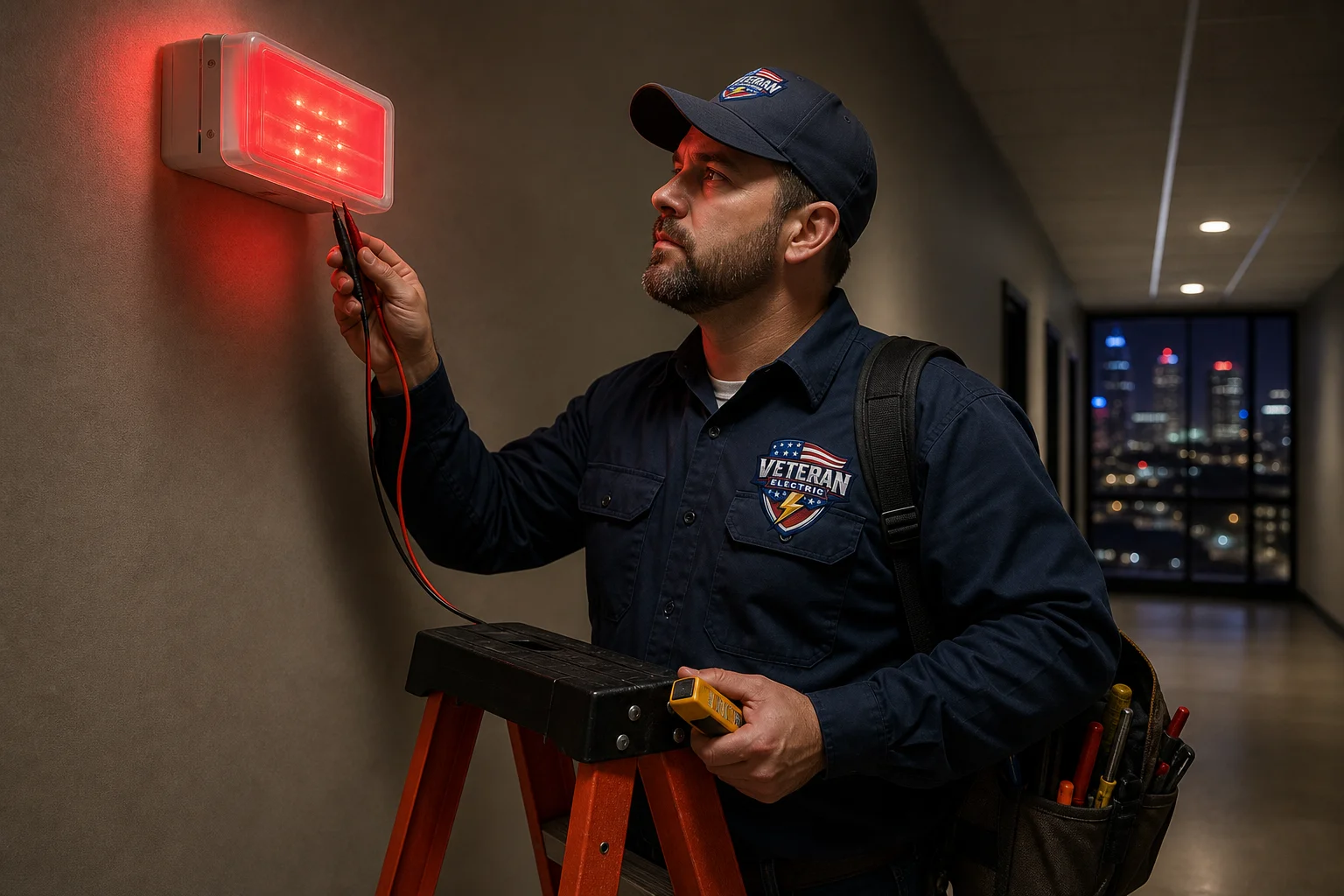
Kansas City fire inspectors do not guess when they walk through your building. They check specific illumination times, testing logs, and signage placement against a checklist, and knowing the emergency and egress lighting rules a KC inspector will check in your building before that walkthrough is the difference between a clean pass and a costly reinspection. Veteran Electric's Commercial Electrical Services team wires, tests, and documents these systems for building owners across the metro.
By Veteran Electric Team, KC Licensed Electricians
What a Kansas City Fire Inspector Checks During an Emergency Lighting Inspection
A KC fire inspector walks your egress path from the farthest occupied room to the public way outside, and checks four things at each fixture: does it illuminate on command, does it hold that illumination for the required duration, is the battery or generator connection intact, and is the fixture unobstructed by stock, signage, or furniture. Inspectors also pull your testing log and compare the dates against what the fixtures' internal self-test indicators show, so a paper record that does not match the hardware is its own finding, and having that key information on hand before the inspector arrives speeds up the whole visit. Walking through the emergency and egress lighting rules a KC inspector will check in your building ahead of time, section by section, turns a stressful walkthrough into a formality.
What Illumination Level Egress Lighting Must Provide
Under NFPA 101 (the Life Safety Code), egress lighting must provide an average of about 1 foot-candle (roughly 10 lux) measured along the walking surface of the exit path, with no point dropping below the code minimum. An inspector with a light meter will spot-check a handful of points along the corridor, not just the fixture output at the source, because a working bulb aimed at the wrong angle can still leave a dark gap in the walking path.
Where Exit Signs and Egress Lights Must Be Placed
Exit signs are required at every door intended for egress, at any point where the path changes direction, and anywhere the nearest exit is not immediately obvious from a person's position in the room. Every emergency exit door must stay unlocked from the inside and clearly marked, even one that is rarely used as a primary entrance. Egress lighting fixtures are placed to cover the entire path in between, including stairwells, corridors, and exit discharge areas outside the building. A general rule inspectors use: if a person walking the path in the dark cannot see the next sign or fixture from where they are standing, there is a gap that needs a fixture.
How Long Emergency Lights and Exit Signs Must Stay On During a Power Outage
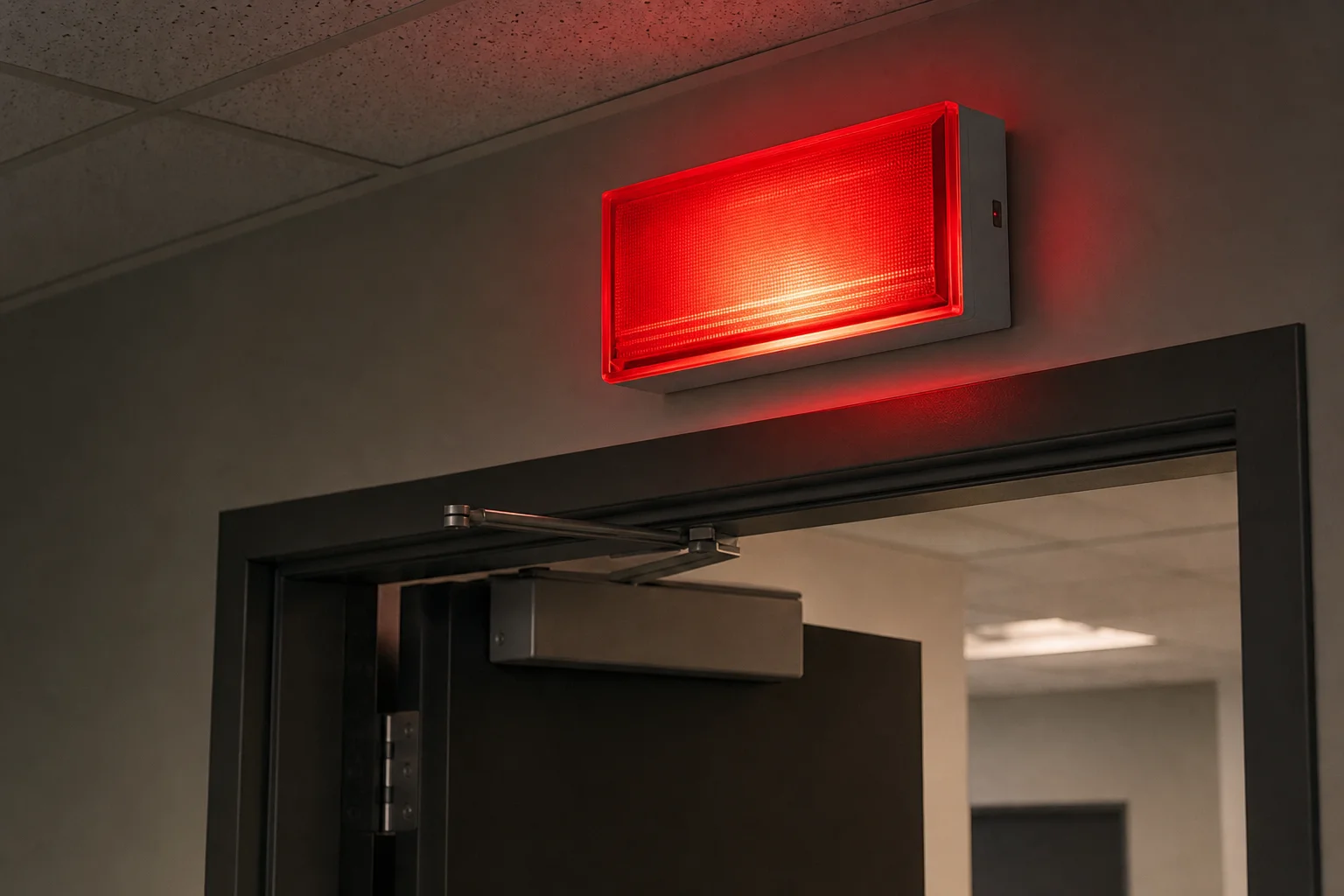
Once normal power drops, emergency lighting and illuminated exit signs are required to switch to battery or generator backup automatically, without a manual switch, and stay lit for a minimum of 90 minutes in most jurisdictions, including Kansas City and the surrounding Jackson County area. That 90-minute window is meant to cover a full evacuation plus the time it takes first responders to arrive and assess the building, not just the first few minutes after the outage starts. Backup batteries that hold a charge for 60 or 70 minutes instead of the full duration are a common finding on older systems that have never been load-tested, which is why the testing section below matters as much as the initial installation.
Testing and Documentation Requirements for Emergency Lighting Systems
Emergency lighting and egress systems are not "install and forget" equipment. Code requires two separate testing intervals, and a building owner who only does one is not in compliance even if every light is technically working, as your local fire department will confirm at inspection.
Monthly Functional Tests vs. Annual Tests
A monthly test is a short functional check, usually 30 seconds, where each fixture is switched to battery power to confirm it illuminates. An annual test is a full-duration test, running every fixture on battery power for the entire required 90 minutes to confirm the battery actually holds a charge that long, not just that it lights up initially. Skipping the annual test is one of the most common reasons a building fails inspection, because a fixture can pass a 30-second monthly check while its battery is too degraded to last more than 20 or 30 minutes.
Who Is Responsible for Maintaining and Documenting Compliance
Responsibility for testing, documenting, and maintaining emergency lighting sits with the building owner or property manager, not the fire department, and not the tenant unless the lease specifically assigns it. A compliant record includes the date of each monthly and annual test, which fixtures were checked, and a note of any fixture that failed and when it was repaired, and building owners should keep that log ready to provide to the inspector on request, not assembled the morning of the walkthrough. Veteran Electric's Emergency Electrical Services team handles both the testing and the written log building owners hand over, so the documentation matches what the hardware actually shows.
Can Self-Testing LED Exit Signs Replace Manual Monthly Testing?
Self-testing LED exit signs run their own internal diagnostic on a set schedule and flag a fault with an indicator light, and most inspectors will accept the self-test log in place of a manually logged monthly check, provided the system's diagnostic history is available to review on site. Self-testing does not remove the requirement for the full annual duration test, though, since that test verifies real battery capacity under load rather than a pass or fail electronic signal. Building owners who install self-testing fixtures still need someone reading the indicator lights and confirming they are actually being reviewed each month, not just installed and ignored.
Which Building Codes Set the Emergency and Egress Lighting Rules a KC Inspector Will Check in Your Building
Kansas City generally enforces emergency and egress lighting requirements through its adopted edition of the International Building Code and International Fire Code, both of which reference NFPA 101, the Life Safety Code, for the specific illumination levels, duration, and testing intervals described above. Local fire departments and the county building department may add amendments on top of the base code, so the exact section numbers and any local variations are worth confirming directly with your jurisdiction's fire marshal's office before a scheduled inspection, and the office can usually provide the relevant code section as a PDF on request. Occupancy type also matters: a general retail space, a healthcare facility, and a high-rise office building can carry different egress lighting requirements under the same base building code depending on occupant load and building height.
What Happens If a Building Fails Its Emergency Lighting Inspection
A failed inspection typically results in a written report listing each deficiency, a reinspection deadline, and in some cases a hold on your occupancy or business license renewal until the deficiencies are corrected. Common failure points are a dead or degraded battery, a fixture that no longer illuminates, missing or obstructed exit signage, and a testing log that does not exist or does not match the hardware. Correcting the deficiencies before the reinspection deadline, with a technician who documents the repair, is usually enough to close out the finding without further penalty and protects the building's occupancy status.
Frequently Asked Questions
Does a small commercial building still need emergency and egress lighting? In most cases, yes. Requirements are based on occupancy type and occupant load rather than square footage alone, so even a small retail space or general office can fall under the same code section as a much larger building. A licensed electrician can confirm which requirements apply to your specific occupancy classification.
Can a building owner do the monthly test themselves instead of hiring an electrician? Many jurisdictions allow the building owner or staff to perform the monthly functional test, as long as it is documented correctly. The annual full-duration test and any repair work generally require a licensed electrician, since it involves verifying battery capacity and code-compliant wiring on live systems.
How much notice does Kansas City typically provide before a fire inspection? This varies by occupancy type and department schedule, and some inspections are unannounced, so building owners should not count on advance notice. Keeping testing logs current year-round, rather than scrambling before a known inspection date, is the more reliable approach for public-facing buildings in Kansas City.
What is the difference between emergency lighting and egress lighting? Emergency lighting refers to any fixture that provides illumination when normal power fails, while egress lighting specifically covers the illuminated path leading occupants out of the building. Exit signs are a related but separate requirement marking the exits themselves. In practice, a compliant system includes all three working together as one protection plan.
Get Your Building Inspection-Ready With Veteran Electric
A licensed electrician can walk through the emergency and egress lighting rules a KC inspector will check in your building before any of it becomes a finding on someone else's clipboard. Contact Veteran Electric to schedule an inspection-readiness visit.


