
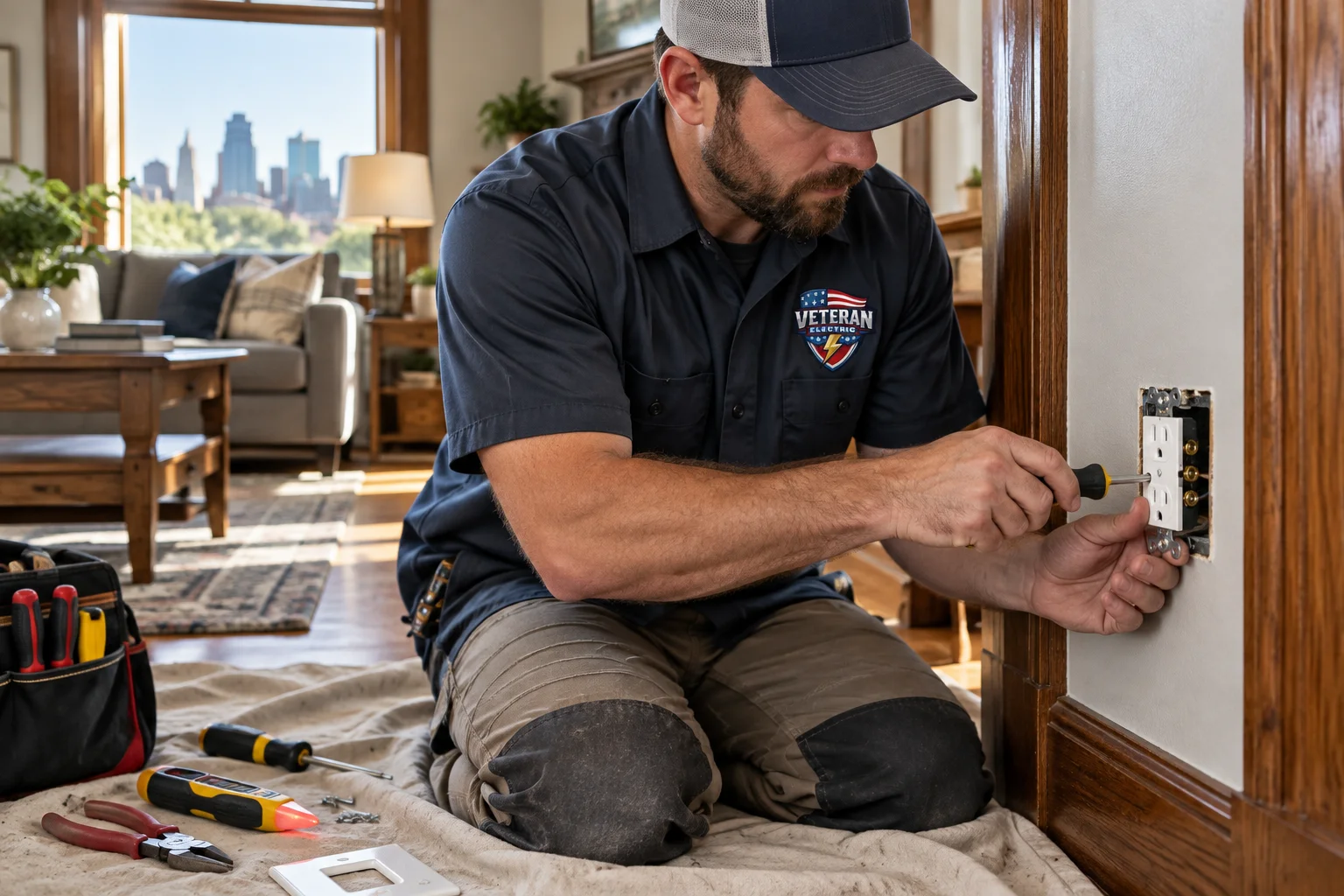
Two-prong outlets in an old KC house almost always mean the home was wired before grounded circuits became standard, and each one raises the same choice: patch it, ground it, or rewire the house. The right call depends on what's behind the wall. Our Residential Electrical Services team sees this across Kansas City's older neighborhoods.
By Veteran Electric Team, KC Licensed Electricians
What Two-Prong Outlets in an Old KC House Really Mean
A two-prong outlet has no third, rounded hole, meaning there's no equipment ground running back to the panel. Kansas City has thousands of older homes built in the 1940s, 50s, and early 60s, before the National Electrical Code required a grounding conductor on every branch circuit. Builders wired these houses with two-conductor cable, hot and neutral only, because that was the accepted standard at the time. Outlets older than that grounding requirement are common across KC's older neighborhoods, and ungrounded outlets by themselves aren't a defect, just a leftover from an earlier code cycle.
Are Two-Prong Outlets Actually Unsafe, or Just Outdated?
A two-prong outlet isn't inherently dangerous the way exposed wiring is, and millions are still in daily use with no incident. The risk shows up with appliances that have a metal case, like an older washing machine or a power tool: they rely on a ground wire to give fault current somewhere safe to go if the internal wiring fails. Without that path, a short inside the appliance can make the metal case carry current, and touching it completes the circuit through a person instead.
Outdated wiring becomes an electrical shock hazard mainly when paired with modern appliances that assume grounded outlets are available. Older homes with mostly older appliances get by for years; the risk climbs as more grounded, three-prong appliances get plugged into two-prong receptacles through adapters or clipped-off ground pins.
GFCI Retrofit vs. Running a New Ground vs. Rewiring: What Each Option Actually Fixes
The real decision is what to do about it: three paths, each solving a different problem.
What a GFCI Retrofit Fixes on an Ungrounded Circuit
A GFCI outlet monitors current going out on the hot wire against current coming back on the neutral, and trips instantly if any is leaking somewhere it shouldn't, like through a person. That's why the National Electrical Code allows a GFCI outlet on an ungrounded circuit as a listed exception, as long as it's labeled "GFCI Protected" and "No Equipment Ground." What it doesn't do is add an actual ground path: surge protectors and three-prong power tools that rely on a real equipment ground for anything beyond shock protection won't get that benefit from a GFCI alone.
Can You Replace a Two-Prong Outlet With a Three-Prong Outlet Without a Ground Wire?
Not legally, not without a GFCI. Swapping a bare two-prong receptacle for an ordinary three-prong outlet with no ground wire behind it isn't allowed, because it makes the outlet look grounded to anyone who plugs in a three-prong appliance or tests it with a cheap outlet tester. The exception the code carves out is a GFCI-protected three-prong outlet, labeled to disclose there's no ground, legal because the GFCI is doing the protecting instead of a ground wire.
When It Makes Sense to Run a New Ground Wire Instead
A GFCI retrofit is fast and inexpensive, but it's a workaround. Running a new ground wire back to the panel, or bonding the outlet box to a nearby grounded path like metal conduit or a grounded water pipe where code allows it, gives you an actual equipment ground instead of just shock protection. That's worth doing when a room has equipment that benefits from a real ground, like a home office with sensitive electronics or a workshop full of power tools, or when a wall is already open for another reason.
How to Tell if a Two-Prong Outlet Is Secretly Already Grounded
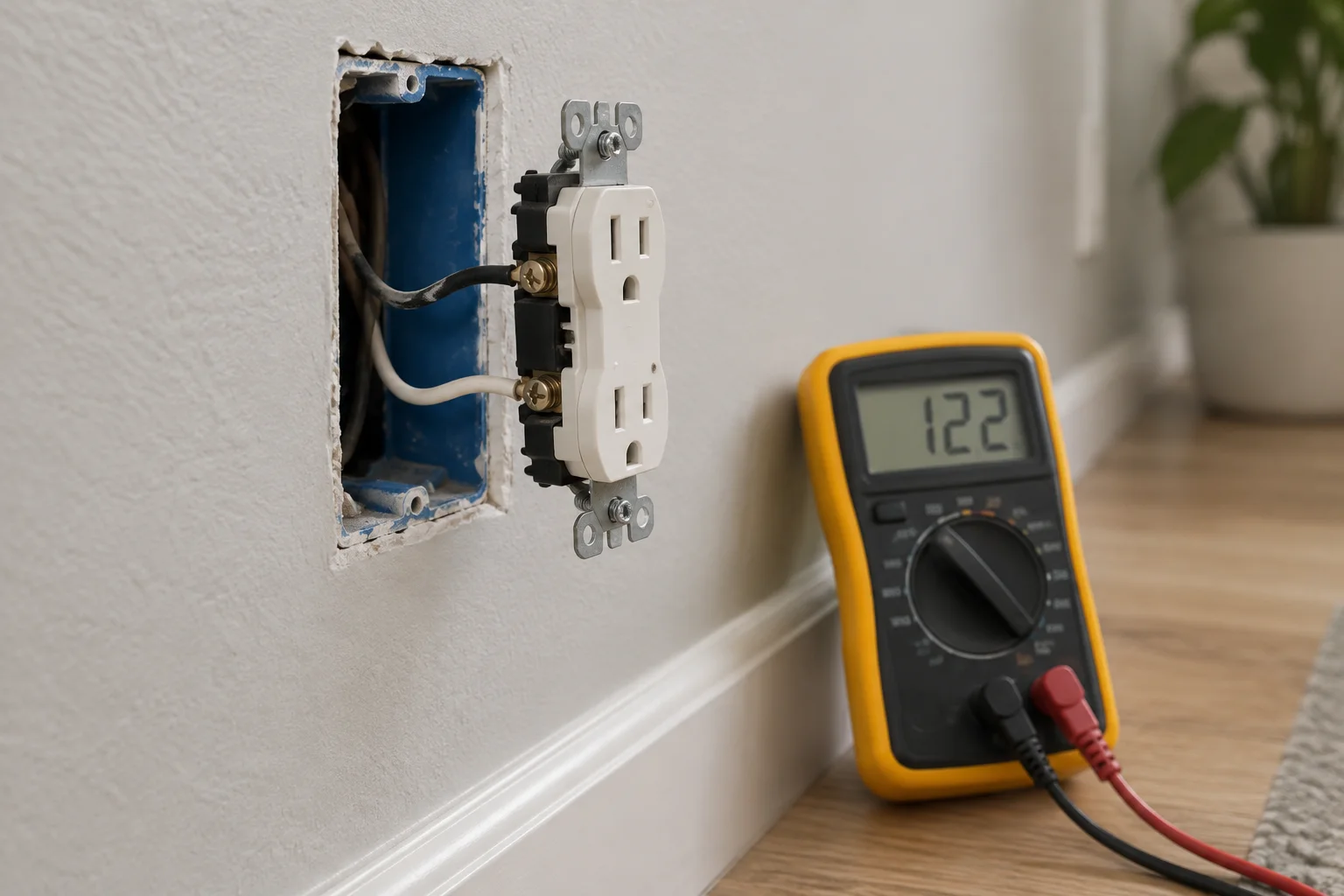
Some two-prong outlets in old KC houses sit on a box that was grounded for another reason. A standard outlet tester won't work on a two-prong receptacle, but a multimeter can, by checking voltage between the hot slot and a known ground like a metal cold-water pipe or a metal conduit box. A reading close to normal line voltage means the box is grounded, and a licensed electrician can swap in a proper three-prong outlet without additional wiring.
Signs Your Old KC House Needs a Full Rewire, Not Just an Outlet Fix
A GFCI retrofit or new ground wire solves a problem outlet by outlet. A full rewire is the answer when the wiring and panel, not the outlets, are the problem. Warm cover plates, a burning smell, repeated breaker trips, and a 60-amp fuse box panel all signal the wiring itself is past its service life. Knob-and-tube wiring and cloth-insulated cable, common in Kansas City houses built before the 1950s, push the decision toward rewiring, since neither is rated for the loads modern appliances draw.
Homes with too few circuits for everything now plugged in are their own signal: dimming lights when the microwave and a window unit run at once, or a single circuit feeding half the house, point to the panel and wiring, not the outlet finish. The more of these aging-wiring warning signs stack up in one house, the less a room-by-room outlet fix accomplishes.
What It Costs: GFCI Retrofit vs. Grounding vs. Rewiring in Kansas City
Cost is where these three options separate the most, though the real answer depends on the house. A GFCI retrofit is the least expensive by a wide margin: a single outlet swap with no wall or panel work, and pricing for a straightforward GFCI outlet swap is driven mostly by how many outlets need upgrading. Running a new ground wire costs more than a GFCI retrofit but less than a rewire, since price depends on how far the outlet sits from a viable ground point and how much wall opening that route requires. A full rewire is the largest investment because it replaces the wiring behind every outlet, along with upgrading the panel to carry modern loads.
Pricing depends on the panel's age, circuit count, and whether the house has plaster walls, so the only reliable way to compare these costs is an electrician's on-site quote. If two-prong outlets in an old KC house have you weighing these options, our team can walk the house, price a GFCI retrofit, a targeted ground, and a full rewire side by side, and tell you honestly which one your wiring needs. Contact us to schedule that walkthrough.
Permits and Timeline for Rewiring an Old House in KC
Kansas City requires a permit for a whole-house rewire, since it involves replacing wiring and typically upgrading the panel. A GFCI retrofit or one added ground wire usually doesn't need a separate permit, though your electrician can confirm the specific scope. Timeline depends on access: an open basement or crawlspace can mean a rewire in days, while finished walls or tight attics take longer.
Frequently Asked Questions
Is it legal to replace a two-prong outlet with a three-prong outlet in Kansas City?
Only if it's GFCI-protected and labeled to disclose there's no ground behind it. An ordinary three-prong outlet on a two-wire circuit falsely suggests the outlet is grounded to anyone who plugs in an appliance or tests it.
How can you tell if a two-prong outlet is secretly already grounded?
A multimeter, not a standard outlet tester, can check voltage between the hot slot and a known ground point like a metal water pipe or outlet box. A licensed electrician can confirm it in minutes and upgrade the outlet if the ground is already there.
Will a GFCI outlet work on a circuit with no ground wire?
Yes. It doesn't need a ground wire to function, it monitors current between hot and neutral and trips if any leaks somewhere it shouldn't. The code allows GFCI protection as a listed alternative to grounding on older circuits, as long as the outlet is labeled to show there's no equipment ground.
Do you need a permit to rewire an old house in KC?
Yes, a whole-house rewire in Kansas City requires a permit and inspection. A GFCI retrofit or adding a ground to one outlet typically falls outside that requirement, but a licensed electrician can confirm what your specific scope needs.
How long does rewiring an old house usually take?
It depends on the house's size and how accessible the existing wiring is. A single-story home with an open basement or crawlspace can sometimes be rewired in days, while a two-story house with finished walls and plaster takes longer, since more of the work involves opening and patching walls.
Get a Straight Answer on Your Two-Prong Outlets
Two-prong outlets in an old KC house rarely need the same fix from house to house, so a real answer means someone looking at your panel, your walls, and how the circuit is routed. If you're already noticing warm outlets, a burning smell, or breakers that won't reset, that's no longer a retrofit-versus-rewire conversation, and our Emergency Electrical Services team can respond directly to that.


