
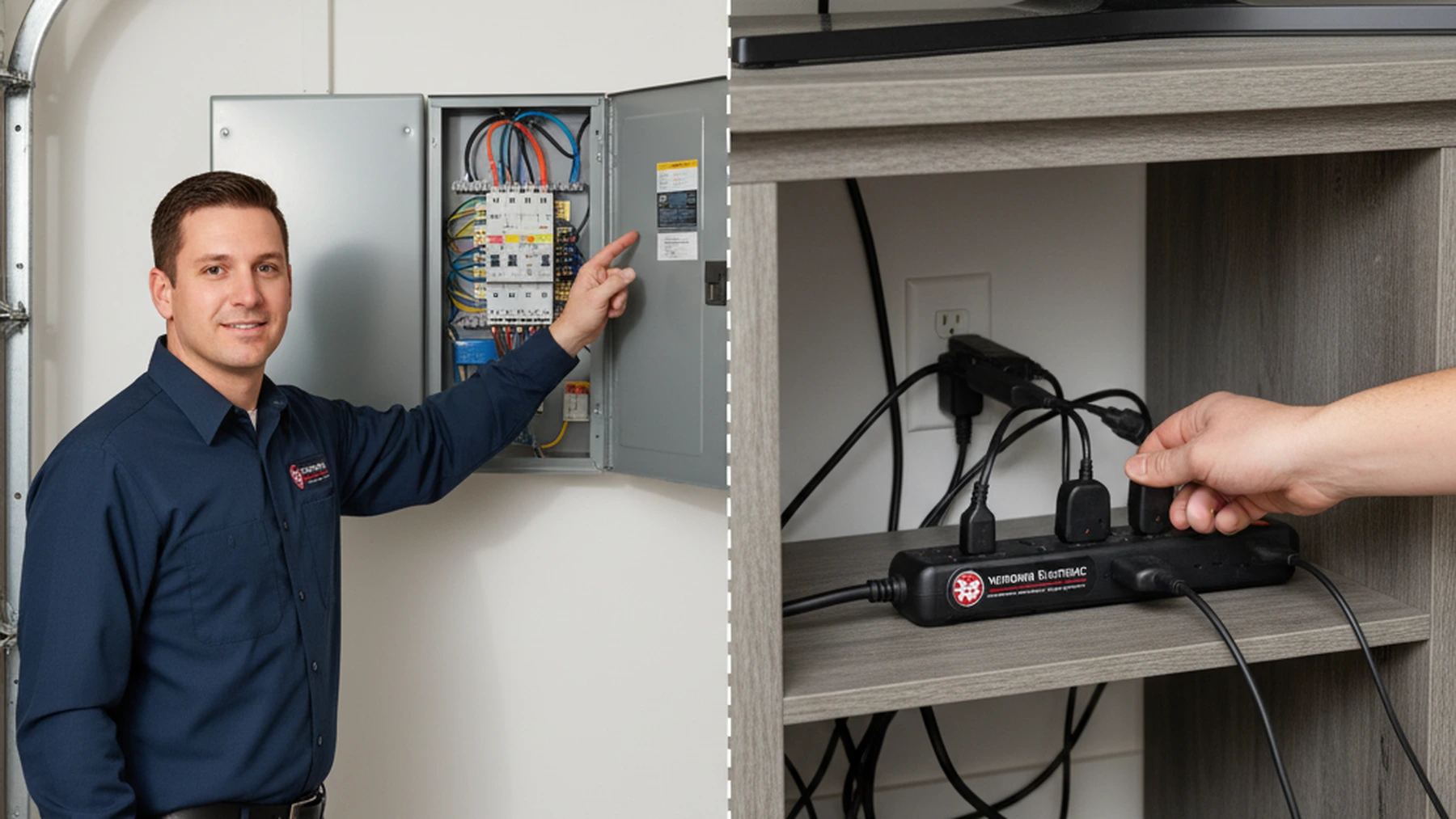
A whole home surge protector installs directly at your electrical panel and guards every circuit in your house from power surges. A power strip with surge protection only covers the devices plugged into it. That's the core difference, and it matters more than most homeowners realize.
Why This Question Comes Up
Walk into any big-box store and you'll see power strips marketed as "surge protectors." Plug in your TV, your gaming setup, your laptop, and you feel like you've done your job. But that strip sitting on your floor isn't the same class of protection as a whole-house surge protector installed at your breaker panel. Not even close.
We answer this question every week in Kansas City. Homeowners ask because their appliances keep getting damaged, because they just bought a new HVAC system or refrigerator, or because a neighbor took a lightning strike and lost thousands in electronics. If you've been wondering whether the surge protection you have is actually enough, this article gives you a straight answer.
What a Power Strip "Surge Protector" Actually Does
A standard surge protector power strip contains metal oxide varistors (MOVs). These components absorb excess voltage and divert it away from connected devices. When a surge hits, the MOVs take the hit.
The problem: MOVs wear out. Each surge, even small ones, degrades their capacity. Most power strips give no indication when the MOVs have been depleted. That "protected" light stays on even when the protection is gone. You think you're covered. You're not.
Power strips also have limits on what they can handle. A direct lightning strike or a large utility surge coming through your service entrance will overwhelm a power strip entirely. The surge bypasses the strip's MOVs and fries whatever is plugged in. This is not a rare edge case. It happens constantly in areas with older grid infrastructure or frequent thunderstorms, both of which apply to the Kansas City metro.
Beyond that, a power strip only protects what's plugged into it. Your refrigerator running on a standard outlet? Unprotected. Your HVAC system? Unprotected. Your washer, dryer, dishwasher, and water heater? All unprotected. Every major appliance in your home runs on circuits that a power strip cannot touch.
What a Whole-Home Surge Protector Does
A whole-house surge protector, also called a surge protection device (SPD) or surge protective device, installs at your main electrical panel or directly after the utility meter. This is a hardwired device, not something you plug in.
When a surge enters your home from outside, whether from a lightning strike nearby, a utility grid fluctuation, or a large motor switching on somewhere in the neighborhood, the whole-home surge protector intercepts it before it can travel through your home's wiring. It clamps the voltage down to a safe level and diverts the excess energy to ground.
This type of protection is rated in kiloamps (kA), which tells you how much surge current it can handle in a single event. NEMA standards classify these devices by type. A Type 1 surge protection device installs on the line side of your service disconnect and handles the largest surges, including direct lightning energy. A Type 2 device, more common in residential installations, mounts inside or adjacent to the main panel and protects against surges from the utility and internal sources.
A whole-home SPD protects every circuit simultaneously. The refrigerator, the HVAC, the sump pump, the home office, the television setup, every outlet and hardwired appliance covered in one installation.
Internal Surges: The Threat Most Homeowners Don't Know About
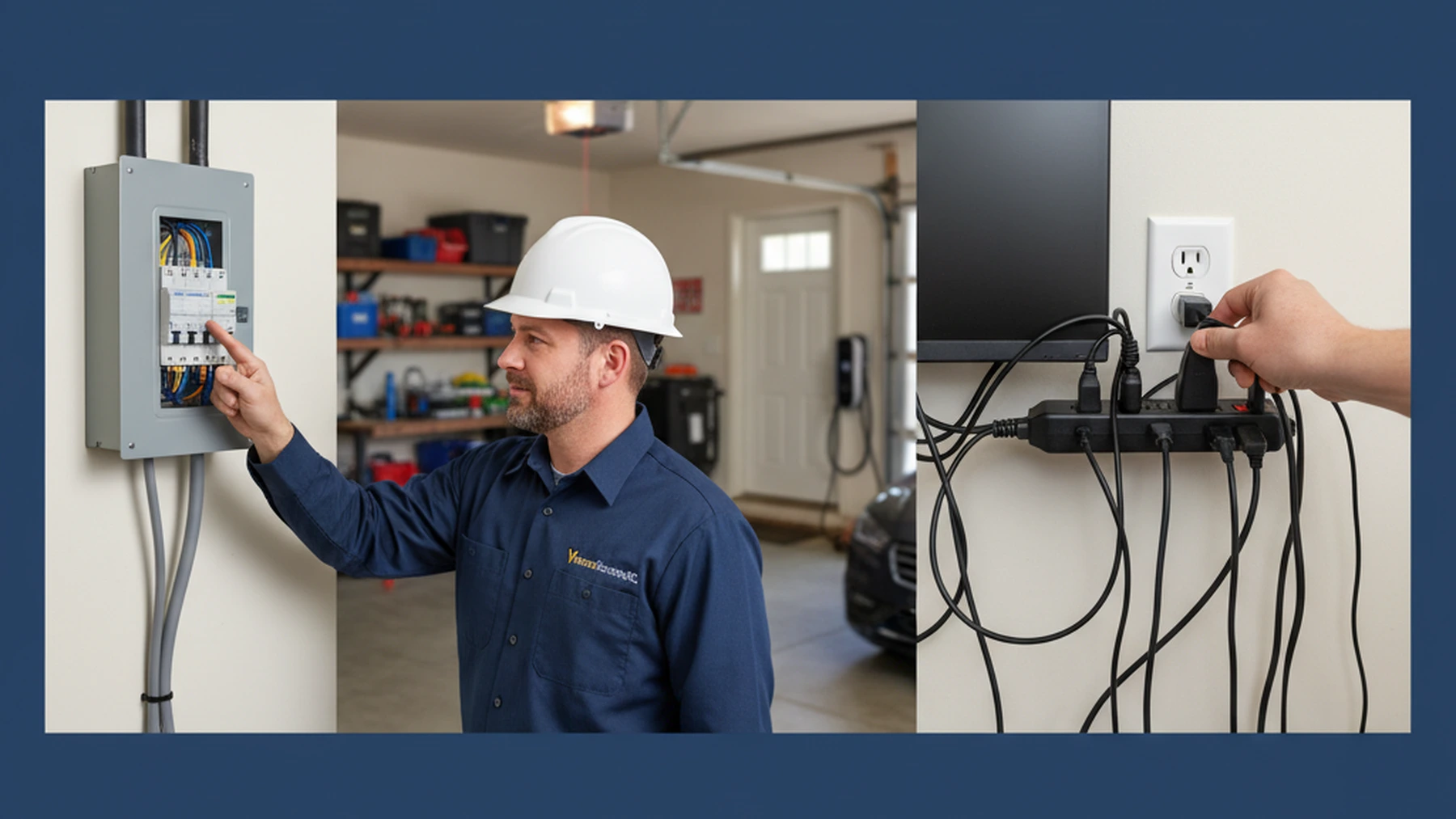
Here's something the power strip conversation usually skips: most power surges don't come from lightning. They originate inside your own home.
Large motors create voltage spikes when they switch on and off. Your HVAC compressor, refrigerator compressor, sump pump, and washing machine all generate internal surges every time they cycle. These surges travel back through your home electrical system and damage sensitive electronics over time. It's cumulative degradation, not a single dramatic event.
A whole-house surge protector handles both external surges coming in from the utility line and internal surges generated by your own appliances. A power strip only sees what comes through that one outlet. It cannot intercept an internal surge generated elsewhere in the house.
The Layered Defense Approach
A properly protected home uses both. This is what we recommend to every client.
The whole-house surge protection device at your electrical panel is your first line of defense. It handles large external surges and clips internal ones. The power strip surge protectors at sensitive electronics serve as point-of-use protection for any residual surge that makes it through. Together, the two layers cover your home comprehensively.
Using only a power strip and skipping the whole-house unit is like putting locks only on your bedroom door and leaving the front door wide open. The protection is real, but it's incomplete.
What to Look for in a Whole-House Surge Protector
Not all whole-house surge protectors are built the same. A few things worth knowing when discussing options with your electrician:
Surge current rating. Measured in kiloamps. Higher is better. Residential installations typically range from 40 kA to 200 kA per mode. A quality unit rated at 80 kA or higher per mode gives you substantial protection.
NEMA type and installation point. Type 1 and Type 2 devices serve different installation positions. Your licensed electrician determines which type applies based on your service configuration.
Indicator light and audible alarm. A proper surge protection device includes a status indicator so you know when the unit needs replacement. Unlike cheap power strips, quality whole-home units tell you when protection has been degraded.
Listed to UL 1449. This is the standard for surge protective devices in the United States. Any unit installed in a home electrical system should carry this listing. It means the device has been tested to perform as claimed.
Warranty. Many manufacturers back quality surge protection devices with a warranty that covers connected equipment if the unit fails to protect against a surge. Read the terms before purchase.
Why Kansas City Homes Need This
Kansas City sits in a region with active thunderstorm seasons and an aging utility grid in many neighborhoods. Internal surges from HVAC systems running hard through hot summers add to the load. Homes in areas like Overland Park, Lee's Summit, Independence, and the KC metro core face repeated surge events throughout the year, most of them too small to notice but significant enough to degrade electronics over time.
If you've replaced a television, a smart appliance, or a piece of electronics that seemed to die for no reason, cumulative surge damage is one of the first explanations worth considering. Whole house surge protection addresses the root cause rather than replacing equipment after the fact.
What Installation Looks Like
A whole-home surge protector installation is not a DIY project. The device wires directly into your electrical panel, which involves live service-entrance conductors. This work requires a licensed electrician and, depending on your municipality, a permit.
At Veteran Electric KC, we pull permits when required, do the work right, and leave your panel cleaner than we found it. The installation itself is straightforward for an experienced electrician. The work is typically completed in under two hours.
Once installed, your surge protection device is there. No power strips to replace, no MOVs silently wearing out with no indicator, no gaps in coverage across your home's circuits. The protection is whole-house because that's exactly what the name says.
Get Whole-House Surge Protection Installed in Kansas City
If you're relying on power strips to protect your home's electronics and appliances, you're working with incomplete coverage. A whole-home surge protector installed at your electrical panel is the only way to protect every circuit under one roof.
The Veteran Electric KC team is ready to assess your home and get the right surge protection device installed. We serve the greater Kansas City area and bring the same precision to every job that we brought to every mission. Schedule your appointment today.
If you're looking at your home's overall electrical health, our residential electrical services cover everything from panel upgrades to outlet installations. And if a surge has already caused damage or you have an urgent electrical concern, our emergency electrical services are available when you need them.
Frequently Asked Questions
Does a whole-home surge protector replace my power strip surge protectors?
Not entirely. A whole-house surge protector at your electrical panel is your primary protection against large surges from the utility line and internal sources. Point-of-use surge protector power strips at sensitive electronics add a second layer of protection for residual surges that make it past the main device. Using both gives you the most complete coverage.
How long does a whole-house surge protector last?
A quality whole-home surge protector typically lasts 5 to 10 years under normal conditions, though this depends on how many surge events it has absorbed. Most devices include an indicator light that signals when the surge protective components have been depleted. Your electrician can inspect the unit during routine service visits.
Can I install a whole-home surge protector myself?
No. The device connects directly to your main electrical panel at the service entrance, where conductors carry full utility voltage. This work requires a licensed electrician and may require a permit depending on your jurisdiction. Attempting this without proper training and licensing creates serious risk of electrocution and fire.
What causes power surges in my home?
Power surges have two main sources: external and internal. External surges come from the utility grid, lightning strikes in your area, or equipment switching on the utility line. Internal surges are generated inside your home by large motor-driven appliances like HVAC systems, refrigerators, sump pumps, and washing machines when they cycle on and off. A whole-house surge protector addresses both.
Is a whole-home surge protector worth it?
Yes, for any home with modern appliances, electronics, or smart systems. The cost of a whole-house surge protection device and professional installation is a fraction of the cost of replacing damaged appliances or electronics after a surge event. When you factor in protecting your HVAC system, refrigerator, washer, dryer, and all connected electronics simultaneously, the value is straightforward.


